


Syrian orphans to be offered help as Cameron promises Britain will be a safe haven for thousands from refugee camps
- Prime Minister to give Commons statement on the UK's new aid effort
- Expectations that he will announce as many as 10,000 will be resettled
- Cameron will against help acting as a 'magnet' to trafficking gangs
- UK aid budget will be used to pay for housing refugees for up to a year
David
Cameron will today promise orphaned children living in Syrian refugee
camps a safe haven in Britain as he announces plans for an escalation in
the UK's humanitarian effort.
Expectations
are growing that the Prime Minister will announce that as many as
10,000 people will be resettled across the UK using money from the
foreign aid budget.
In
a statement to MPs, Mr Cameron will insist that the UK stands ready to
help those fleeing for their lives from the Assad regime and barbaric
ISIS militants.
But
he will reject calls from Brussels for Britain to accept a share of the
tens of thousands of people already on European soil, warning any offer
of help should not act as a 'magnet' for more to make the perilous sea
crossing to reach safety.

David Cameron will today announce
details of a plan for Britain to take thousands of Syrian refugees
living in makeshift camps in north Africa
In
less than a week Downing Street has been forced into a major policy
u-turn, after repeatedly refusing to drop its opposition to large
numbers of people being given refuge in the UK.
The
harrowing images of three-year-old Ayan Kurdi's body on a Turkish beach
last week triggered a major public outcry and forced Mr Cameron into
retreat.
Senior
politicians including Labour's Yvette Cooper, Scottish First Minister
Nicola Sturgeon and Green leader Natalie Bennett joined singer and
campaigner Bob Geldof in offering to put up refugees in their own homes.
Some
2,000 people have said they would be willing to house Syrians in spare
bedrooms, but council leaders have dismissed the idea as 'pie in the
sky', insisting town halls need extra government funding to cope with
any influx.
MPs return to the House of Commons for the first time after their summer break today, with the issue set to dominate.
Mr Cameron has vowed to stand by his commitment to spend 0.7 per cent of GDP on international aid.
But
he is expected to tell MPs that the budget can be used to help with the
housing and living costs of refugees for their first year in Britain.
It
will mean that the UK can increase its offer to the humanitarian effort
without having to make cuts to domestic budgets at a time when
Chancellor George Osborne is demanding reductions of up to 40 per cent
in some budgets.
The
Prime Minister will make clear that refugees given help under the
expanded resettlement scheme will come directly from camps in Syria and
neighbouring countries, and not those who have already crossed into the
European Union.
Mr
Cameron and other senior ministers are concerned that signing up to an
EU plan to disperse 160,000 people across the continent will encourage
more people to attempt to make the perilous journey in dangerous boats.
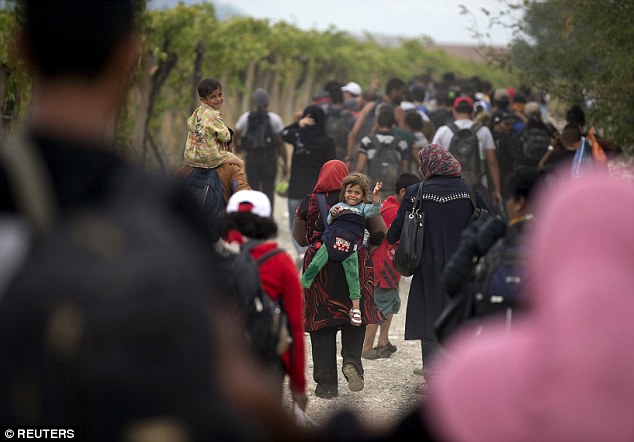
Migrants walk along a dirt road after crossing the Macedonian-Greek border near Gevgelija, Macedonia

Migrants board a train after crossing the Macedonian-Greek border near Gevgelija, Macedonia, yesterday
Under
the Brussels plan, migrants stranded in Italy, Greece and Hungary will
be transferred to countries across the EU based on their population and
economic wealth.
It will see Germany granting asylum to 35,000 refugees, France accepting 26,000 and Spain 16,000.
Even poverty-stricken Bulgaria and Romania will be expected to take thousands of families.
But
Britain will use an opt-out to refuse to accept the forecast 17,000 it
would be obliged to accept, instead offering to help those in camps.
A survey showed the public’s lack of enthusiasm for thousands more coming in.
The
Mail on Sunday poll found nearly one in three people said Britain
should not accept any Syrian migrants on top of existing asylum
seekers.
One in six said Britain should take less than 1,000.
Mr
Osborne has ordered a fundamental rethink of the way Britain's aid
budget is used, shifting away from alleviating poverty to trying to
bring stability to the Middle East.
He
told BBC One's Andrew Marr Show: ‘In the short-term we’re going to take
more refugees, but not in a way that encourages them on to these
dangerous boats.
‘In
the longer term, I think we need a fundamental rethink of our aid
policy, so yes, we support reducing poverty but we also direct our
additional aid spending to these failed states, to this refugee crisis,
to the big threats facing Britain.
‘So
the question in the spending review is not just how does our aid budget
help the rest of the world, but how does it help Britain’s national
interest.’
Revelations
about wasteful aid projects, corruption, donation to countries with
their own aid budgets and even space programmes have increased public
opposition to growing aid spending at a time of cuts at home.
Officials
said all the additional spending over the coming years will be
ringfenced for use on ‘global challenges’ such as the Syrian refugee
crisis.
That could means some £1billion diverted to responding to major international crises by the end of the decade.
Britain
is already the biggest donor of humanitarian aid to the Syria crisis in
the EU, second only to the United States globally.
On
Friday Mr Cameron announced an extra £100million on top of £920million
committed to date, meaning the UK has contributed more than Germany,
Netherlands, France, Italy, Hungary, Austria and Poland combined.
Today
a United Nations commissioner has said its humanitarian agencies are
'financially broke' as the organisation attempts to provide aid for
tens of thousands of people fleeing war.
UN
high commissioner for refugees Antonio Guterres said basic needs are
not being fulfilled as he called for EU member states to fund aid in the
same way they fund UN peacekeeping operations.
He
warned agencies like UNHCR and Unicef could become bankrupt as they are
struggling to keep up with the basic needs of millions of people who
have fled Syria and are travelling towards Europe.
Mr
Guterres said the number of people displaced by conflict each day has
risen by 31,000 in a four-year period, placing a greater strain on
resources to provide refugees with the things they need.
He told the Guardian: 'If you look at those displaced by conflict per day, in 2010 it was 11,000; last year there were 42,000.
'This means a dramatic increase in need, from shelter to water and sanitation, food, medical assistance, education.
'The budgets cannot be compared with the growth in need. Our income in 2015 will be around 10 per cent less than in 2014.
'The
global humanitarian community is not broken - as a whole they are more
effective than ever before. But we are financially broke.'
He
said the crisis which has arisen out of Syria, where people are fleeing
both President Assad's regime and Islamic State forces, must be
recognised as an emergency and the aid effort funded as by assessed
rather than just voluntary contributions.
Tory
MP Andrew Mitchell, a former International Development Secretary,
called for a 'massive effort from the international community'.
He
told BBC Radio 4's Today programme: 'We need to create safe havens. I
think there should be one on the Turkish border at Idlib and another one
on the border of Jordan.
‘We need a serious effort to protect the millions of people in what is now a second world country.
‘We
need to be involved in putting troops on the ground. This is a
humanitarian effort. It’s important for the UN to help. We have a
responsibility to protect these people.'


0 comments:
Post a Comment